
Adaptive Impedance Control with Payload-Mass Estimation for Aerial Catching
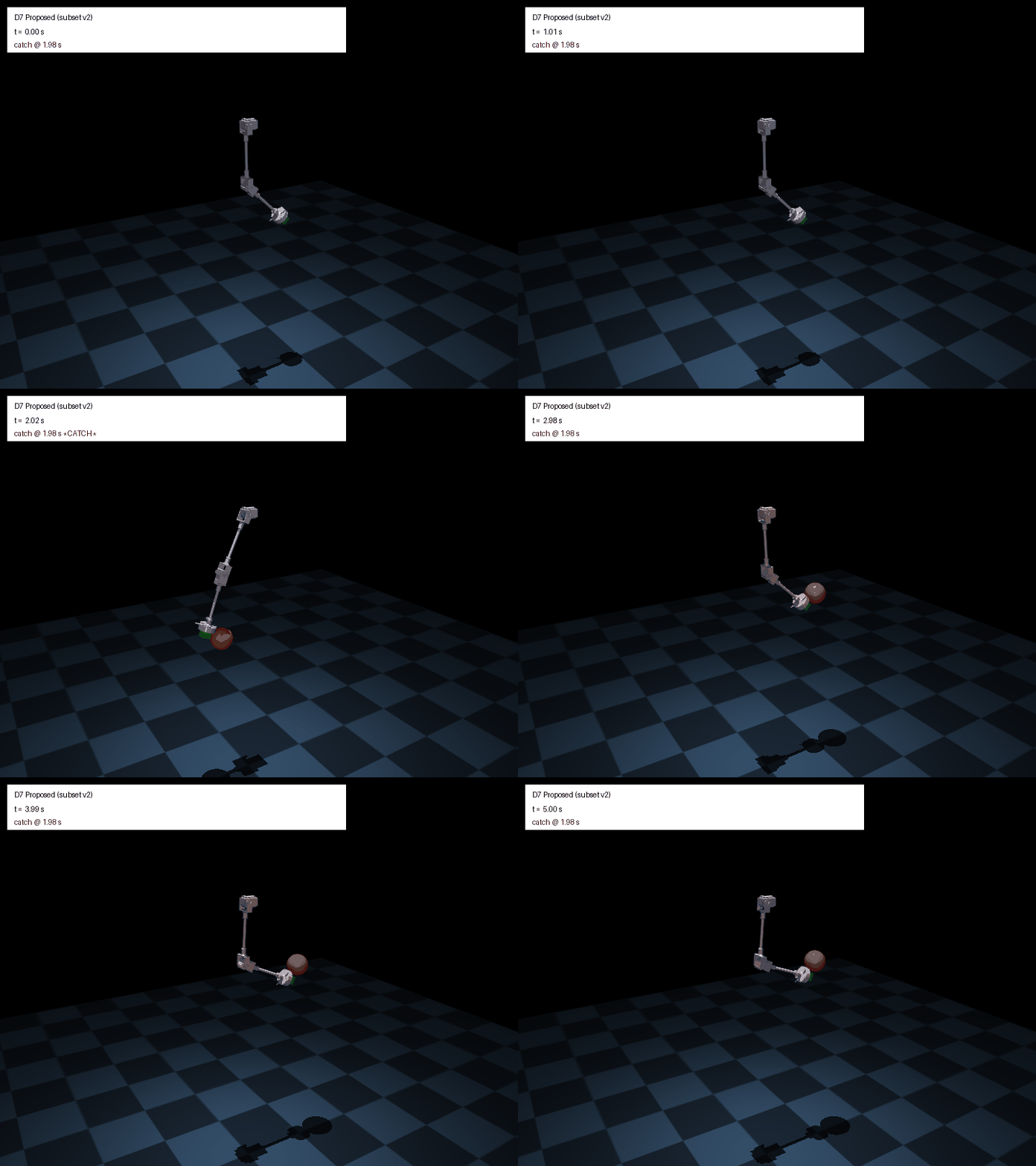
The scenario I keep returning to
Picture a 2R planar arm mounted on a hovering quadrotor. Someone throws a ball into its workspace. The arm has to catch the ball, settle the contact, and do all of that without transmitting a wrench to the base that the attitude controller cannot absorb. Most aerial-manipulation work handles one of those three things well. This thread is my attempt to look at all three together, because in practice they are not separable.
What the controller is trying to do
Three ideas sit on top of standard impedance control:
- Payload-mass estimation runs in the milliseconds right after impact. The estimate enters the impedance law directly, so the usual stiff-to-soft tradeoff softens once the arm knows what it is holding.
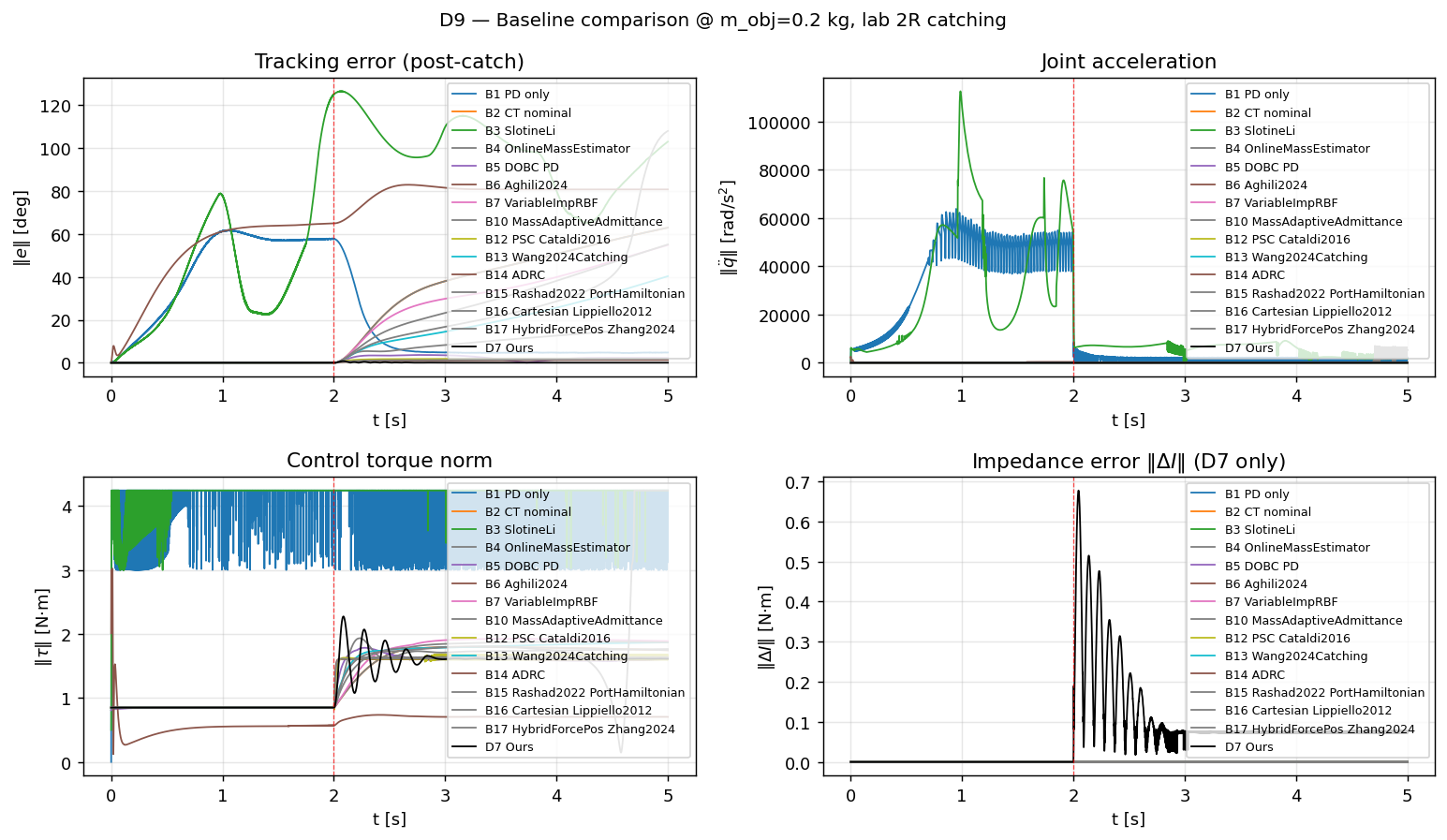
- Like-for-like comparison. The numbers I am willing to publish are the ones that hold up against PD, sliding-mode, and naive-adaptive baselines on identical catching trajectories. The comparison is the experiment, not an afterthought.
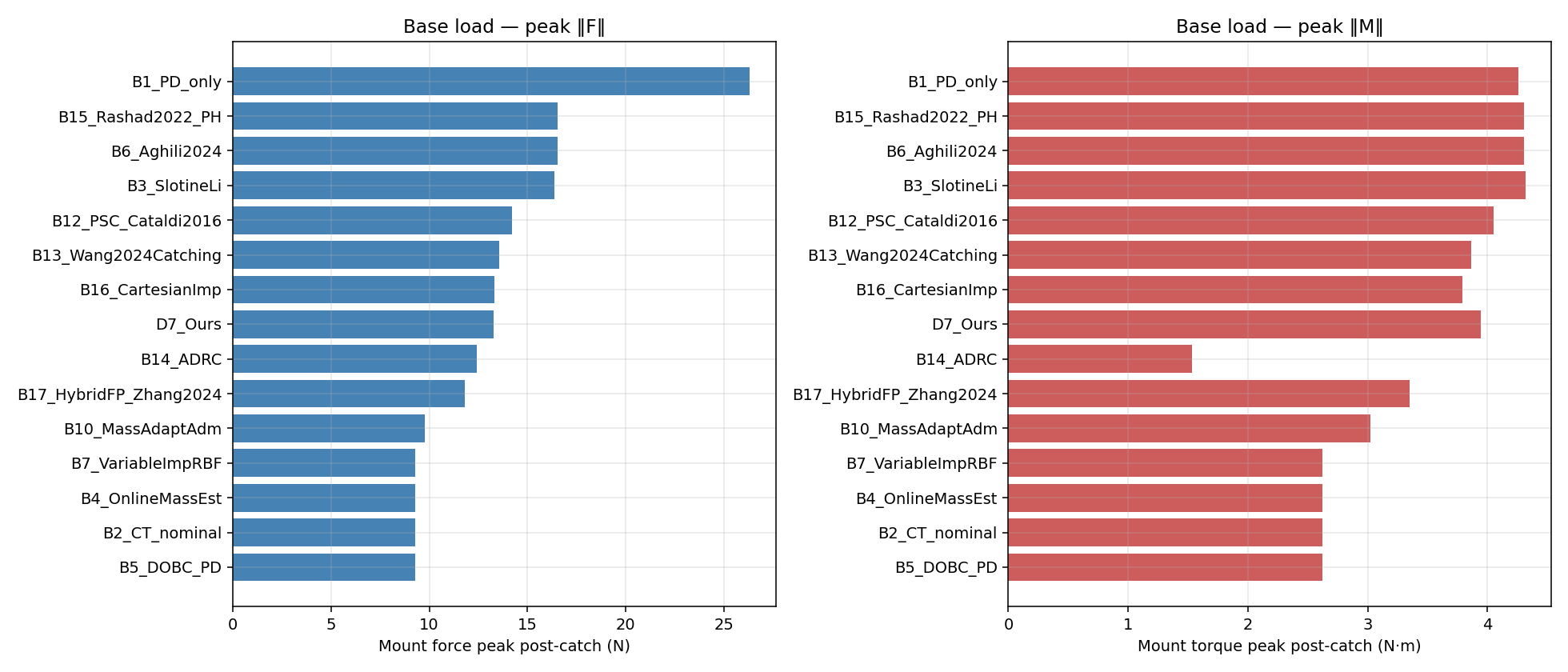
- A base-wrench audit. Tip-tracking error gets most of the attention in aerial manipulation papers; the wrench transmitted to the base usually does not. Both are measured here, and the base wrench is treated as a first-class metric rather than a footnote.
Benchmark snapshots
A sixteen-controller benchmark on a shared catching scene, with identical impact conditions. The cuts are intentionally honest: the controller I am exploring does not win every column. It wins the ones I argue matter most for whether something like this could fly outside a lab.
Video
This is one of the threads I am currently exploring, and a fair illustration of where my research interests sit: contact-rich aerial manipulation, where the controller, the model, and the platform all have to be honest with each other.